iPod Anniversary: Apple’s 2001 Music Player Marks 25 Years
A quarter-century after Steve Jobs unveiled a device that fit 1,000 songs into a card-sized body, the original iPod’s legacy is cemented in tech history.
By Elena Menon ·
Apple’s original iPod turns 25 today, marking a quarter century since the device that redefined portable audio was first shown to the world. On October 23, 2001, then-CEO Steve Jobs took the stage to reveal what he initially teased as a breakthrough digital device that was not a Mac. The gadget, priced at $399, promised to carry an entire music library in a user's pocket, a claim that would prove transformative for the consumer electronics market. By combining a hard drive with a minimalist interface, the iPod established itself as the definitive always-carry device for gadget enthusiasts during the era before smartphones fully matured.
The launch occurred at a pivotal moment for the Cupertino-based company. Jobs had already steered Apple out of its beige-box era into the Mac OS X period, with the iBook and iMac lines successfully revitalizing the brand’s fortunes. This revival came during a challenging economic landscape, shortly after the dot-com bubble burst. Jobs envisioned the Mac as the central hub for a user’s digital life, connecting cameras, camcorders, and DVD players. He identified portable music as a massive, untapped market lacking a clear leader, making it the ideal next step for Apple’s ecosystem.
At the time of the announcement, the portable music market was fragmented. Companies like Creative, Sonic Blue, and the giant Sony had already released digital players, but Jobs argued that none had found the right formula. He noted that consumers were choosing between CD players, MP3 CD players, flash-based devices, and hard disk-based jukeboxes. Apple opted for the hard disk approach, believing it offered the optimal balance of capacity and usability for a mainstream audience.
The device itself was introduced as an MP3 player capable of delivering CD-quality sound and supporting MP3, WAV, and AIFF formats. Its 5GB storage capacity was the headline feature, allowing it to hold 1,000 songs. Specifically, this referred to 1,000 typical pop tracks encoded at 160Kbps. Jobs emphasized that for the average user, this capacity effectively meant carrying their entire personal music collection.
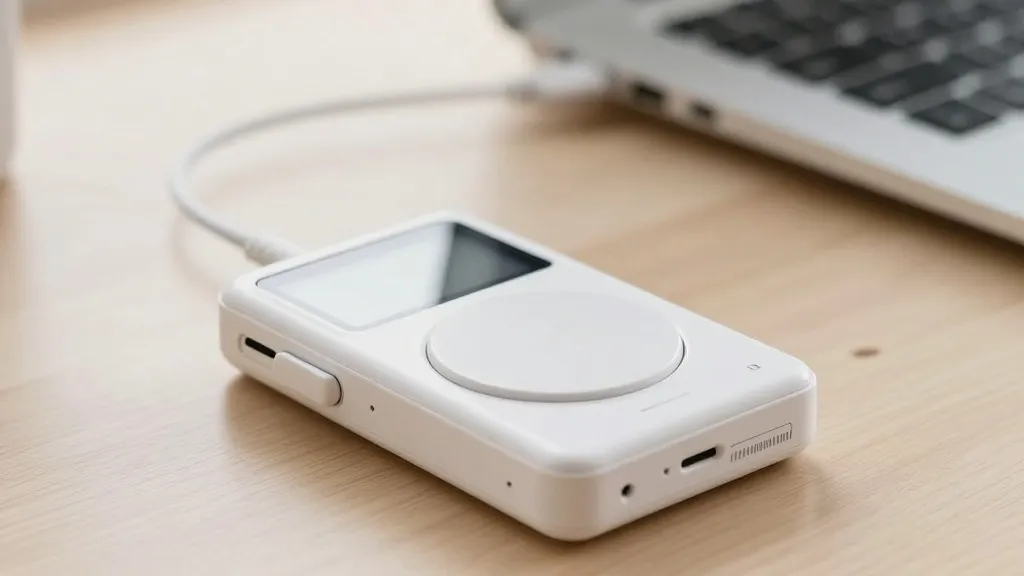
The physical design was a critical component of the product’s appeal. The iPod measured 2.4 by 4 by 0.78 inches, roughly the size of a standard deck of cards. It weighed just 6.5 ounces, making it lighter than most cell phones of the era. This compact form factor was made possible by a 1.8-inch diameter hard drive from Toshiba, which was just 0.2 inches thick. The hardware supported advanced features such as 20-minute skip protection and fast file transfers via a single FireWire 400 cable.
Connectivity was a major selling point, with Apple marketing the iPod as the first and only music player with FireWire. Jobs claimed the connection speed was sufficient to transfer an entire CD of music in five to 10 seconds, a significant improvement over USB connections that could take up to five minutes for the same data. Filling the entire 1,000-song library was estimated to take only 10 minutes, compared to five hours for a typical USB-based player. The device also featured a rechargeable lithium-polymer battery that provided 10 hours of continuous playback and could be recharged to 80 percent in one hour.
The user experience was centered on simplicity and tactile feedback. Jobs highlighted the device’s minimal design and the integration of an accelerated scroll wheel with a piezoelectric clicker, which provided tactile feedback for one-handed operation. This allowed users to quickly locate and play music by playlist, artist, or song. During the on-stage demonstration, the first track played was 'Building a Mystery' by Sarah MacLachlan.
Software integration was the final pillar of the iPod’s strategy. The device launched alongside iTunes 2, which introduced features like MP3 CD burning and syncing support. The Auto-Sync feature ensured that any library created or curated on a Mac was automatically mirrored to the iPod upon connection. The device also functioned as a FireWire hard disk drive, adding utility beyond music playback.
The iPod’s dominance would last for over a decade, coexisting with the iPhone, which launched in early 2007. As smartphones evolved, the standalone music player’s relevance gradually declined. The final model, the 7th-generation iPod Touch, was released in May 2019. Although the line was left without updates for several years, Apple officially discontinued the product in May 2022, closing the book on a device that had fundamentally changed how the world listens to music.
Today, the 25th anniversary of the original iPod serves as a reminder of the device’s impact. It stood as a testament to Apple’s ability to merge hardware innovation with intuitive software, creating a product that resonated with millions. While the specific technology has been superseded by streaming and smartphones, the original iPod remains a landmark in consumer electronics history.
Source: Tom's Hardware · original report published