Pompeii Artifact: Sealed Cupboard Reveals Daily Life Before 79 CE Eruption
Archaeologists uncovered a wooden storage unit containing coins, amulets, and cooking tools, offering a detailed look at the routines of an anonymous resident in the ancient Roman city.
By Elena Menon ·
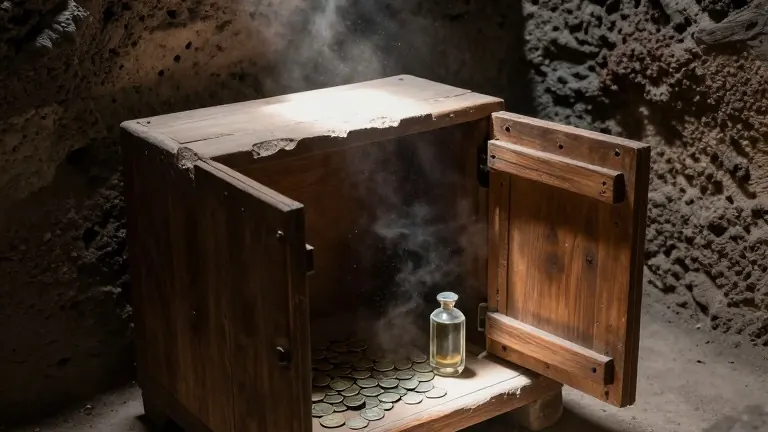
Resident items in a Pompeii home were preserved by volcanic ash, providing a direct view into the material habits of a single individual. The collection includes personal care tools, currency, and protective jewelry that remained behind when Mount Vesuvius erupted in 79 CE.
Archaeologists reconstructed the wooden cupboard from fragments found in a house on Via dell'Abbondanza. This street was one of the busiest thoroughfares in the ancient city. The site director, Gabriel Zuchtriegel, stated that while the occupant’s identity cannot be confirmed with certainty, the artifacts offer a close look at their daily existence.
The cupboard contained a necklace known as crepundia, composed of at least 24 small items made from bone, glass paste, earthenware, and rock crystal. The pieces included images of the gods Bes and Mercury, along with miniature hands, feet, pine cones, and grapes. Roman children typically received these necklaces as protective charms and rattles. Adults sometimes retained them as mementos of their youth.
Beyond the jewelry, the storage unit held practical tools for household management. Items recovered included tweezers, a small glass bottle for perfume or ointment, and an incense burner. Bronze, glass, and ceramic vessels sat alongside cooking pots. A wooden box contained lead weights, indicating that the resident likely participated in commercial trade. A woven container held 38 bronze coins.
The presence of both currency and sentimental items suggests the household had limited time to retrieve belongings after the eruption began. Zuchtriegel noted that ordinary objects restore the human dimension of the past. He added that the value of this discovery lies in reading the different traces of a life, including personal habits, work, and memories, together.
The house is tentatively linked to a man named Cornelius Maximus based on inscriptions found within the structure. The facade was first excavated in 1912. However, archaeologists only recently investigated the rooms behind it as part of a wider restoration project. The site is located in a central area of Pompeii near Naples.
The excavation also yielded evidence of persistent urban challenges. Researchers found the fragmented skeletons of two young mice inside an amphora. The container was situated on a raised storage area. This finding indicates that some problems of city living have remained consistent over two millennia.
Source: The Jerusalem Post