
Bay of Bengal Cyclone: Storm Hits India's Data Center Coast
Cyclone Arnab killed three people and damaged 200,000 acres of farmland in Andhra Pradesh, threatening a $15 billion tech hub.
By Elena Menon ·
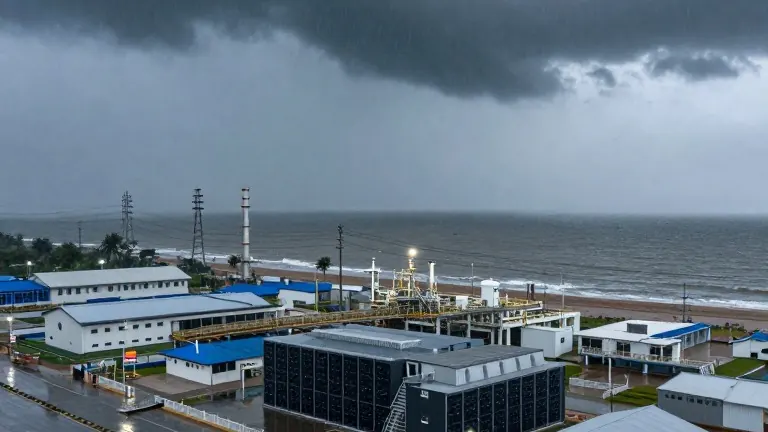
Eastern India’s coastline has become a major hub for digital infrastructure, with billions of dollars in data center projects planned along the Bay of Bengal. That growth met a hard stop on Wednesday when Cyclone Arnab made landfall in Andhra Pradesh.
The storm killed three people and flooded approximately 200,000 acres of cropland, according to local authorities. Heavy rains, not wind, posed the greatest danger to inland areas as the system weakened. Meteorologists linked the storm's rapid intensification to unusually warm ocean temperatures and a humid atmosphere that retained more moisture.
K.J. Ramesh, a former director general of the Indian Meteorological Department, explained that warmer air holds more water vapor. This increases the potential for intense downpours. Akshay Deoras, a weather expert at the University of Reading, noted that while cyclones are natural, human-caused warming amplifies their rainfall. The storm arrived after India experienced its weakest southwest monsoon since 2015, a dry spell driven by El Niño conditions.
The timing is critical for the tech industry. Visakhapatnam, which lay in the path of the storm's heavy rains, is the site of a planned $15 billion hyperscale data center. Google, Adani, and Airtel are the investors behind that project. The facility joins a growing cluster of similar infrastructure along the coast, a region now facing increased exposure to extreme weather events.
Anjal Prakash, a public policy professor at Flame University in Pune, warned that early damage assessments often miss indirect economic costs. Households and small businesses typically absorb the first financial hits through damaged assets and lost wages. Many lack insurance or savings, making recovery difficult. These costs can strain government budgets, potentially reducing spending on schools, healthcare, and transport.
A 2025 report by climate-risk firm XDI analyzed 228 Indian data centers. It projected that more than one in ten would face high damage risks from climate change by 2050 under a high-emissions scenario. Prakash stated that these facilities face overlapping threats from flooding, heat, and power instability. He argued that planning based on historical weather patterns underestimates current risks.
Prakash emphasized that infrastructure must be designed for future climate conditions. This includes strengthening electricity grids and flood-proofing roads and housing. Businesses need continuity plans for multiple simultaneous failures, such as a storm followed by power cuts. Deoras added that while forecasting for large systems has improved, local thunderstorms and flash floods remain difficult to predict.
India and its neighbors plan to seek predictable adaptation finance at upcoming global climate talks in Turkey. Prakash said funding must reach frontline communities quickly. He urged simpler access to United Nations loss and damage funds to help rebuild before losses become irreversible.
Source: WTOP News