Moscow Banks on El-Dabaa Nuclear Plant as African Trade Hits $27 Billion
Egypt accounts for nearly 40% of Russia's continental commerce, yet Moscow's diplomatic push faces stiff competition from the EU and China.
By Elena Menon ·
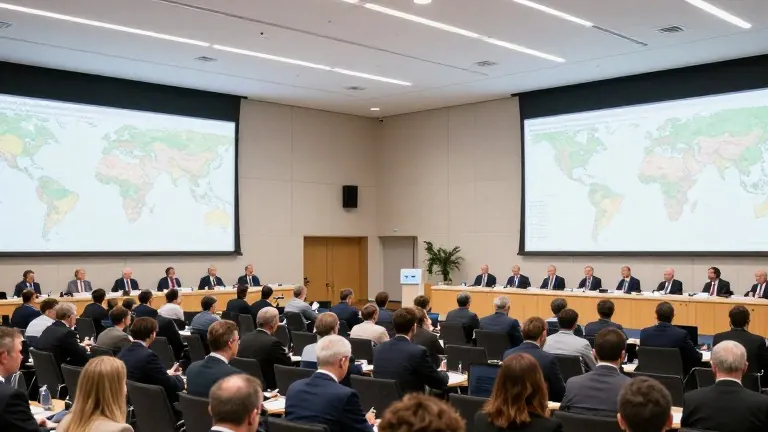
The third Russia-Africa summit opened in Moscow on October 28, a date that coincides with the continent representing 3.9% of Russia's total foreign trade in 2025. Russian President Vladimir Putin uses the gathering to reinforce ties with African nations following his full-scale invasion of Ukraine. The two-day event focuses primarily on economic cooperation, though the agenda also touches on security, science, and culture.
Egypt has emerged as the cornerstone of this economic strategy. According to the Russian Federal Customs Service, bilateral trade between the two nations reached $10.5 billion in 2025. That figure represents a more than doubling of the volume recorded in 2021. Russian grain and metal products dominate the exports, while Egypt ships fruit and vegetables in return. The country now absorbs 39% of all Russian trade with the 54 nations on the continent.
A major infrastructure project anchors the partnership in the El-Dabaa region on the Mediterranean coast. Russia is constructing a large nuclear power plant there, financed by a $25 billion loan that covers roughly 85% of the project's costs. Ivan Klyszcz, an analyst with the International Centre for Defence and Security in Tallinn, Estonia, notes that while South Africa has the largest national economy in Africa, its trade volume with Moscow remains far smaller than that of Egypt and Algeria.
The disparity between diplomatic activity and economic scale is stark. Total sales between Russia and all African countries amounted to approximately $27 billion in 2025. By comparison, the European Union traded $385 billion with the continent, China exceeded $348 billion, and the United States reached nearly $105 billion. Fidel Owusu, a Ghanaian expert at Geopolitical Intelligence Services in Liechtenstein, observes that middle powers like Turkey and the United Arab Emirates often outperform Russia in trade volume and investment quality.
Moscow's influence extends beyond commerce into the military sphere. The Africa Corps, a paramilitary group controlled by the defense ministry, has taken over operations previously run by the Wagner Group. These units support regimes in unstable Sahel nations in exchange for access to raw materials. The Congressional Research Service reports that the largest Russian military contingents, each numbering several thousand men, are stationed in the Central African Republic, Mali, and Libya. The group is also seeking to expand its footprint in Burkina Faso, Niger, and Equatorial Guinea.
Arms sales remain a key metric of influence, though they have declined during the war in Ukraine. The Stockholm International Peace Research Institute estimates that Russia held a 15% share of the African arms market between 2021 and 2025. That places Moscow in third position behind the United States, which held 19%, and China, which held 17%. During the prior period from 2020 to 2024, Russia led the market with a 21% share.
Russian officials frame their engagement as a partnership rather than an extraction of resources. Maria Zakharova, the foreign ministry spokesperson, described the continent's relationship as a historic return. Putin stated at the Valdai Discussion Club that Russia aims to develop with Africa rather than simply make money or steal from it. This anti-colonial narrative resonates in some regions, particularly South Africa, though perceptions vary across the 54 member states.
Source: Deutsche Welle