
PennFuture releases model ordinance to manage stormwater from new warehouses
The proposal encourages towns to adopt wider stream buffers, citing the runoff challenges posed by expanding industrial and data center projects in Pennsylvania.
By Elena Menon ·
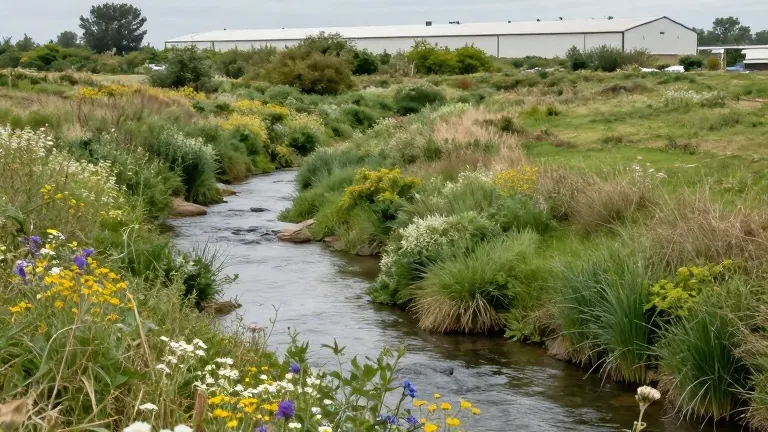
PennFuture published a model ordinance this week to help Pennsylvania municipalities manage stormwater from large-scale development. The document provides a framework for local governments to require green stream buffers, a move driven by the rapid expansion of warehouses and hyperscale data centers across the state.
The release follows a trend of major land-use changes that cover hundreds of acres with paved surfaces. These impervious surfaces generate thousands of gallons of runoff during rain events. Brigitte Meyer, a staff attorney at PennFuture, stated that projects of this scale have a massive impact on water resources. The organization aimed to create a universal tool rather than reacting to each new development individually.
Riparian buffers are planted areas of native vegetation located on either side of waterways. The model ordinance is designed as a working document for towns to adapt into local law. Meyer noted that these buffers offer multiple benefits, including flood mitigation and sediment removal before water enters streams. They also provide habitat for animals and create corridors for wildlife movement.
The ordinance applies to any town willing to adopt it and includes provisions for buffers along wetland borders. Meyer acknowledged that some municipalities are already using this concept while others are unfamiliar with it. The document suggests buffer widths ranging from 100 to 150 feet on either side of a waterway, with some cases extending up to 300 feet.
Murrysville officials have implemented similar measures in the past. Emily Mallisee, the community development director, pointed to a buffer at Murrysville Community Park near Farm Road. That project served a dual purpose, improving the aesthetic and recreational value of the area while protecting the headwaters of Steele’s Run, a high-quality stream.
Financial considerations play a role in adopting such measures. Communities in the state’s Municipal Separate Storm Sewer System program receive annual targets from the Department of Environmental Protection for sediment control. These targets often represent an unfunded mandate. Mallisee said that riparian buffers help meet these goals without the recurring maintenance costs associated with manmade facilities.
Raegan McKelvey, program coordinator for the Jacobs Creek Watershed Association, noted that buffers require less maintenance than mowed banks. In Oakmont, a buffer along Plum Creek in Dark Hollow Woods requires repairs due to erosion and invasive species. That work is part of the borough’s comprehensive plan for the park’s long-term sustainability.
PennFuture developed the ordinance because state law only requires buffers in specific circumstances, leaving gaps that local governments can address. Meyer said the organization scaled buffer sizes based on the overall size of the development to balance land use needs. The full text of the ordinance is available on the PennFuture website.
Source: Pittsburgh Tribune-Review