House Control Hinges on 46 Battlegrounds and New Maps in Seven States
With a 218 to 214 split, Democrats need a net gain of three districts to take the House, a margin that hinges on volatile seats in the Southeast and newly drawn boundaries.
By Hassan Bello ·
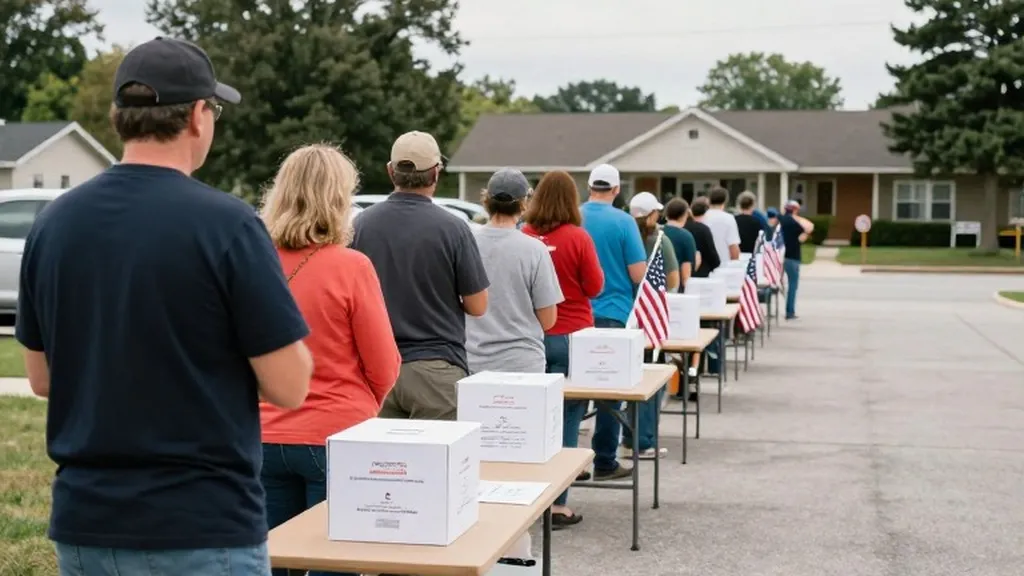
Voters across the United States are heading to polling places on Election Day to decide which party will control the U.S. House of Representatives for the final two years of President Donald Trump's second term. All 435 House seats are up for grabs in this midterm election. According to Ballotpedia, Republicans currently hold 218 seats while Democrats hold 214, with one independent and vacancies remaining. This narrow gap sets the stage for a tightly contested race where every district matters.
The arithmetic of the House race is precise and unforgiving. Democrats need a net gain of three districts to secure a majority. Conversely, Republicans can afford to lose no more than two seats to maintain their control of the chamber. This three-seat margin makes the outcome highly sensitive to performance in competitive districts. The Associated Press notes that one or two seats could tip the balance of power in either chamber, highlighting the razor-thin nature of the current landscape.
Ballotpedia identifies 46 battleground districts that will likely determine the final outcome. Of these, 25 are currently held by Democrats and 21 by Republicans. The composition of these districts is critical because of their recent voting patterns. Twenty-one Democratic-held districts voted for Trump in the 2024 presidential election. In contrast, nine Republican-held districts voted for Kamala Harris in the same cycle. These crossover districts represent the most vulnerable seats for both parties as they fight for the three-seat margin.
The geographic focus of this contest is heavily weighted toward the Southeast, where several states are using new congressional maps following mid-decade redistricting. The states using new maps include California, Florida, Missouri, North Carolina, Tennessee, and Texas, with Ohio also utilizing a new map. In the Southeast, Florida and North Carolina are particularly significant due to their new district lines. In Florida, polls are open from 7 a.m. to 7 p.m. In North Carolina, polls open at 6:30 a.m. and close at 7:30 p.m. These new maps may not vote exactly as drawn, a concern raised by Republicans who used redistricting to try and beat the typical midterm pattern of the president's party losing seats.
In Georgia, polls are open from 7 a.m. to 7 p.m., and the state is part of the group of seven states with new maps. The state has one open governor's seat and a Senate race involving incumbent Jon Ossoff. In South Carolina, polls are open from 7 a.m. to 7 p.m., with an open governor's seat and a Senate race involving incumbent Darline Graham. In Tennessee, poll hours vary by county, and the state has an open governor's seat and a Senate race involving incumbent Bill Hagerty. In Alabama, polls are open from 7 a.m. to 7 p.m., with both an open governor's seat and an open Senate seat. In Mississippi, polls are open from 7 a.m. to 7 p.m., with a Senate race involving incumbent Cindy Hyde-Smith and no governor's race.
The political mood entering the day is defined by economic anxiety. The Associated Press describes the election as a referendum on Trump's second term, with voters struggling with high prices and angry over an unpopular war with Iran. An AP-NORC poll shows that 35% of U.S. adults approve of Trump's job performance, while 25% approve of his handling of the economy. About seven in ten say the country is heading in the wrong direction. Most blame the president for high prices. This economic pressure is a key factor in the 46 battleground districts where voters are deciding whether to retain or switch party control of the House.
Republican leadership is focused on turnout as the primary driver of success. RNC Chairman Joe Gruters stated that everything depends on turnout, asserting that if they turn out their voters, they win. Democrats are described as cautiously optimistic. DCCC Chair Rep. Suzan DelBene said the American people are angry and want change. The fight for the House is not just about national sentiment but about local mobilization in the 46 competitive districts. The new maps in states like Florida and North Carolina add a layer of complexity, as these districts are being tested for the first time under their new boundaries.
The election administration has faced legal challenges that could impact how votes are counted and certified. A federal judge temporarily barred the Trump administration from carrying out a plan to prevent noncitizen voting, a move critics say risks disenfranchising eligible voters. Another judge ordered the administration to stop demanding that California election officials segregate ballots cast by people on lists of suspected noncitizens. The U.S. Postal Service added hours and staff to ensure mail ballots are counted on time. These administrative issues are occurring while more than 57 million people had already voted as of Monday, surpassing early vote totals from four years ago in many closely watched states.
Financial resources have played a significant role in shaping the campaign landscape. The 2026 elections are likely to be the most expensive in history. Republican committees outraised and outspent Democratic committees, aided by Trump-affiliated groups and Elon Musk. However, at the candidate level, Democrats outraised their opponents. According to an AP analysis of AdImpact data, 88.1% of Republican general election TV ad spending went to states and districts Trump won in 2024. This included more than $850 million spent in areas where he won by 10 points or more. This spending strategy reflects the Republican focus on protecting their 218 seats and limiting losses to no more than two.